
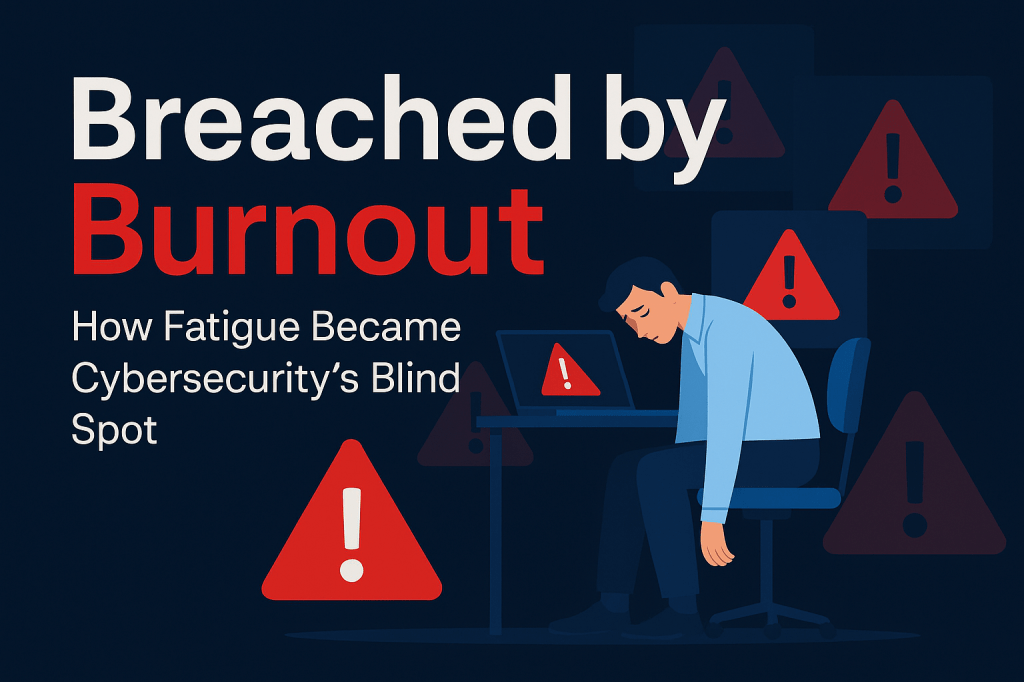
Imagine walking into a dimly lit office. It’s 7 a.m., but the tension’s been building long before your shift starts. You sit at your desk, facing giant monitors flashing RED, YELLOW, ORANGE, and GREEN. The alerts stack fast—some critical, most noise. Every one demands attention. Behind your tired eyes and caffeine-fueled focus is the weight of an entire organization. One mistake could cost millions. Disrupt operations. Burn it all down.
“71% of SOC analysts say they’re likely to quit their jobs due to overwhelming alert fatigue and lack of work-life balance.” — Devo SOC Performance Report, 2023
We ignore SOC fatigue at our own risk. Hackers know this. Why wouldn’t they flood a SOC with false positives just to wear the team down—then strike when everyone’s numb?
They’re not just exploiting software. They’re exploiting human limits.
The Noise Problem
The average SOC sees thousands of alerts daily—many irrelevant or false. Analysts triage endlessly, hoping to catch the one that matters. Eventually, pattern recognition becomes desensitization.
When everything’s urgent, nothing feels real.
Click fatigue sets in. Judgment fades. The 48th PowerShell alert gets ignored—just like the last 47. But what if that one was real?
“On average, organizations use around 40 different security tools—some deploy up to 130—creating a fragmented environment that overloads SOC analysts and leads to alert duplication, integration issues, and missed threats.” — Mindflow & RSA Conference
The real breach doesn’t always come from the outside. Sometimes, it’s the 43rd false positive that finally breaks someone.
The Human Cost
Burnout doesn’t always look like collapse. It looks like indifference. It’s the analyst who stops escalating because they’re drowning in alerts. The one who rubber-stamps a ticket just to move on—because it’s the bottom of the priority list (think: lost and stolen devices). Not because they don’t care—but because they can’t care anymore.
The average SOC analyst stays just over two years. Replacing and training combined can take 7–12 months. And with each departure, you lose not just headcount—you lose Intuition. Experience. Context. The stuff that doesn’t live in runbooks.
You can’t automate that back. The replacement needs time to learn those things—and that only comes with experience. And experience takes time.
Rethinking Resilience
We talk about resilience like it’s a stack: redundancy, uptime, backups. But what about human resilience? The ability to stay sharp at 2:47 a.m.?
Burnout doesn’t build resilience. It dismantles it.
It’s time to redefine what a strong security posture really means:
- Track alert quality, not just volume
- Rotate shifts and enforce real rest
- Use AI to reduce mental load—not add to it
- Build culture that’s secure by empathy, not just secure by process
Process, tools, and platforms alone don’t protect people and networks—people do.
Resilience starts with them. If they fail, everything else does too. Tools can only do so much—the humans behind them are what make them work, evolve, and matter.
Closing Thoughts: Fatigue Is the New Vulnerability
We scan for open ports and unpatched systems—but the most exploited vulnerability might be sitting at the keyboard. Fatigue doesn’t trip alerts. But it quietly erodes your defenses until the moment someone misses what matters.
You can patch CVEs. You can’t patch burnout. But you can design around it.
That design starts with recognizing that your SOC isn’t just a technical environment—it’s a human one. And humans have limits.
Protect your people like you protect your perimeter. Because they are the perimeter.
 the-perimeter-project.com
Leave a comment